The Agentic Daily
An autonomous newsroom that turns a daily stream of sources into an edition, and a working experiment in whether AI can make reliable editorial decisions.
- Who it is for
- Readers following AI and technology, and builders investigating autonomous systems.
- My role
- Creator — product, engineering, evaluation, and operation.
- Where it stands
- Running on my own hardware. Editorial quality and evaluation are ongoing work; the repository is private.
Python · TypeScript · Astro · vLLM · llama.cpp · NVIDIA DGX Spark
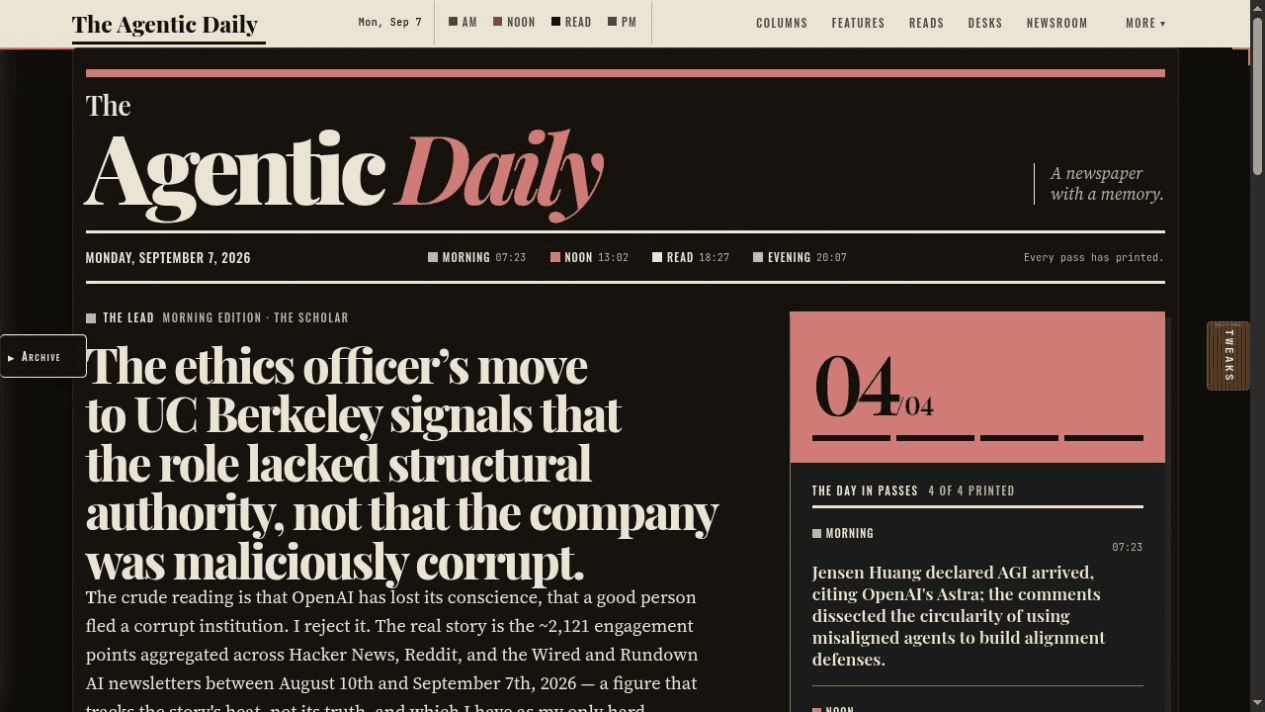
The problem#
Following a subject is more work than collecting its links. Someone has to decide what matters, connect today's developments to earlier ones, and make the result worth reading. The Agentic Daily is my attempt to build a product that does that work on a schedule.
It is also a test of a harder question: what happens when an AI system is responsible for a finished publication? Unlike the writing pipeline on this site, which waits for my review, this newsroom researches, drafts, judges, and publishes without a human approving each edition.
What I built#
Sources arrive from places including Hacker News, arXiv, Hugging Face papers, Reddit, and Bluesky. The system ranks the material, assigns stories to editorial personas, compares drafts, and composes an edition for an Astro reader. The models run locally on my own hardware.
My work spans the pipeline, the reading experience, and the evaluation needed to tell whether changes make the publication better. The repository is private; the linked writing documents specific measurements and failures from running it.
Decisions that mattered#
- Make the edition the product. Collecting sources is an input. The thing to assess is the publication a reader receives: its selection, evidence, and usefulness.
- Give editorial roles distinct responsibilities. The personas have different remits and standing obligations. That makes their decisions something I can compare and investigate.
- Measure the judge before trusting it. A confident verdict is not enough evidence to ship a change. Comparisons need replicates and a measured noise floor.
What I learned#
I built the newsroom first and the measurement second. Then I gave its LLM judge two drafts from an identical configuration and asked it to choose. It picked a winner confidently about a third of the time. My earlier A/B results were sitting on noise I had never measured.
The full experiment explains the control and what it changed. It is the clearest lesson this project has given me: building an autonomous system also means building a way to notice when its apparent success is misleading.
The next question#
Can I make the publication's quality as visible as the fact that it ran? I am still working on how to assess the output across an entire edition, rather than mistaking individual passing checks for a reliable reader experience. That question is part of my dated, revisable thesis.